
Photonics is the study and application of light, encompassing its generation, control, and detection. It spans a range of uses, including telecommunications, imaging, and healthcare. Advances in photonics have supported modern electronics, enhanced scientific research, and contributed to the creation of new materials and devices.
Photonics semiconductors are specialised materials that manipulate light to achieve superior electronic performance. They form the basis of devices such as photodetectors, lasers, and optical sensors, offering higher speed and efficiency compared with traditional electronic components. These semiconductors have become integral to modern technology, supporting data-intensive applications and next-generation computational systems.
Significance of Photonics Semiconductors in Technology
Photonics semiconductors accelerate the transmission and processing of information, which is fundamental for modern communication networks. Their capabilities improve the speed, capacity, and reliability of optical systems used in data centres, telecommunications, and internet infrastructure. Beyond communication, these semiconductors are instrumental in sensing technologies, including medical imaging and environmental monitoring, enabling precise measurements and advanced diagnostics.
The use of light in semiconductors provides distinct advantages over conventional electron-based circuits. Photonic devices reduce heat generation, lower energy requirements, and support miniaturised, high-performance systems. These characteristics make photonics semiconductor a key contributor to technological growth and innovation across various sectors.
Understanding Photonics Semiconductors
Photonics semiconductors merge optical and electronic functions to control light at micro- and nanoscale levels. They often consist of materials such as gallium arsenide (GaAs), indium phosphide (InP), or silicon photonics, each with properties suited to specific applications. Devices built from these semiconductors include optical transceivers, modulators, lasers, and photodetectors, which convert, manipulate, or detect light efficiently.
This integration of light-based processes allows systems to operate faster and with greater precision than traditional electronics. For example, photonic chips in data centres can handle multiple data streams simultaneously, dramatically increasing bandwidth and reducing latency. In sensing applications, photonic semiconductors detect subtle environmental changes, offering high-resolution measurements for scientific and industrial use.
Innovations in Photonics Semiconductors
Recent developments in photonics semiconductors focus on higher efficiency, smaller form factors, and enhanced integration with electronics. Innovations include silicon photonics for low-cost optical interconnects, quantum dot lasers for precision imaging, and integrated photonic circuits that combine multiple optical functions on a single chip.
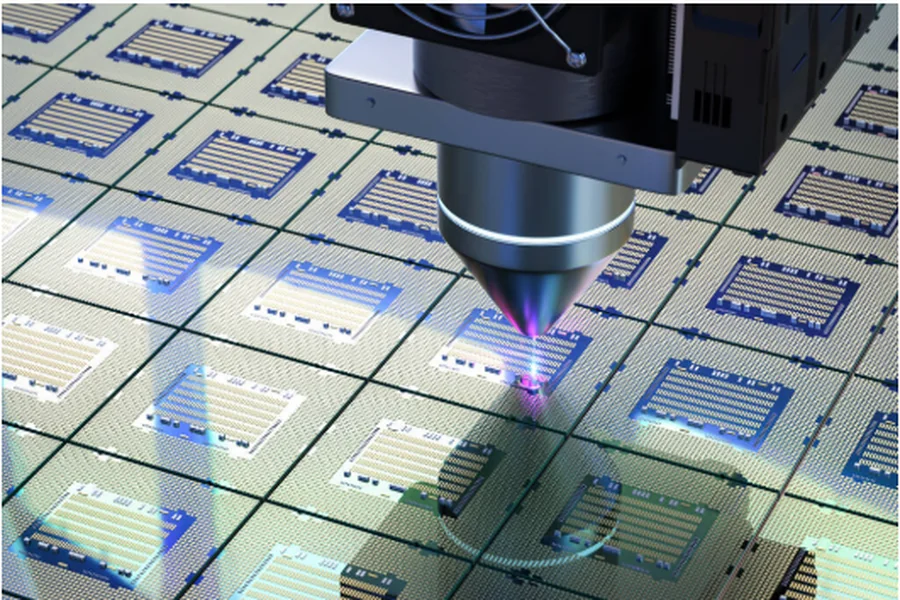
Advances in fabrication techniques, such as wafer-scale manufacturing and nanoscale patterning, have improved device reliability and performance. Researchers are also exploring hybrid materials, which combine conventional semiconductors with emerging compounds to achieve better light-matter interaction and broader wavelength coverage.
These innovations not only improve existing technologies but also enable new applications in artificial intelligence, augmented reality, and high-speed computing. Photonics semiconductors are becoming a foundation for next-generation devices requiring compact, energy-efficient, and high-performance components.
Applications of Photonics Semiconductors
Photonics semiconductors are widely applied across industries. In telecommunications, they support fibre-optic networks, increasing data transfer rates and reducing energy consumption. In computing, photonic chips assist in high-speed interconnects, improving data centre efficiency and reducing heat output.
Medical imaging devices benefit from photonics semiconductors through enhanced sensitivity and resolution. Sensors built from these materials monitor environmental parameters, detect chemical compounds, and support precision measurements in industrial settings. Even consumer electronics leverage photonics devices in cameras, LiDAR systems, and optical storage solutions.
Sustainable Energy Solutions Through Photonics
Photonics semiconductors contribute to energy efficiency and sustainability. They improve solar cell performance by converting sunlight into electricity more efficiently and enhancing energy storage systems. Lighting technologies using photonic semiconductors offer long-lasting, low-energy alternatives to conventional bulbs. Additionally, optical communication networks powered by photonic devices reduce the carbon footprint associated with energy-intensive data transmission, supporting green technology initiatives.
Prospects in AI and Quantum Computing
Artificial intelligence and quantum computing benefit from photonics semiconductors due to high-speed data transmission and parallel processing capabilities. Photonic chips allow AI systems to manage vast amounts of information with minimal latency. Quantum computing systems use photonics semiconductors for qubit generation, manipulation, and readout, enabling faster computation and more scalable quantum devices.
By integrating photonics into these emerging technologies, researchers anticipate breakthroughs in machine learning, complex simulations, and secure communications, creating opportunities for unprecedented computational power and novel applications.
Conclusion
Photonics semiconductors represent a transformative technology, bridging the gap between light and electronics. Their applications span telecommunications, computing, healthcare, and sustainable energy, offering faster, more efficient, and environmentally friendly solutions. Continuous innovation in materials, fabrication, and integration drives further possibilities, supporting advances in AI, quantum computing, and precision sensing. As industries adopt these devices, photonics semiconductors are set to play an increasingly important role in shaping future technology and scientific discovery.
Photonics Semiconductor FAQs
- What is a photonics semiconductor?
A photonics semiconductor is a material designed to manipulate light for electronic applications, including data transmission, sensing, and signal processing. These devices provide high efficiency and speed by combining optical and electronic functionality. - Who is leading in photonic chips?
Industry leaders include established technology companies and innovative startups specialising in optical technologies. These organisations develop advanced photonic chips for communication, computing, and sensing applications, driving performance improvements and new capabilities. - What is the difference between photonic chips and traditional semiconductors?
Photonic chips utilise light waves to transmit and process data, offering higher speeds and lower energy consumption than electron-based semiconductors. Conventional semiconductors rely on electron flow and dominate electronic circuits, but have limitations in speed and thermal efficiency. - Are photonic chips real?
Yes, photonic chips are commercially available and actively used in telecommunications, computing, and sensing devices. Their ability to process light-based signals allows faster data handling, reduced energy use, and support for next-generation technologies